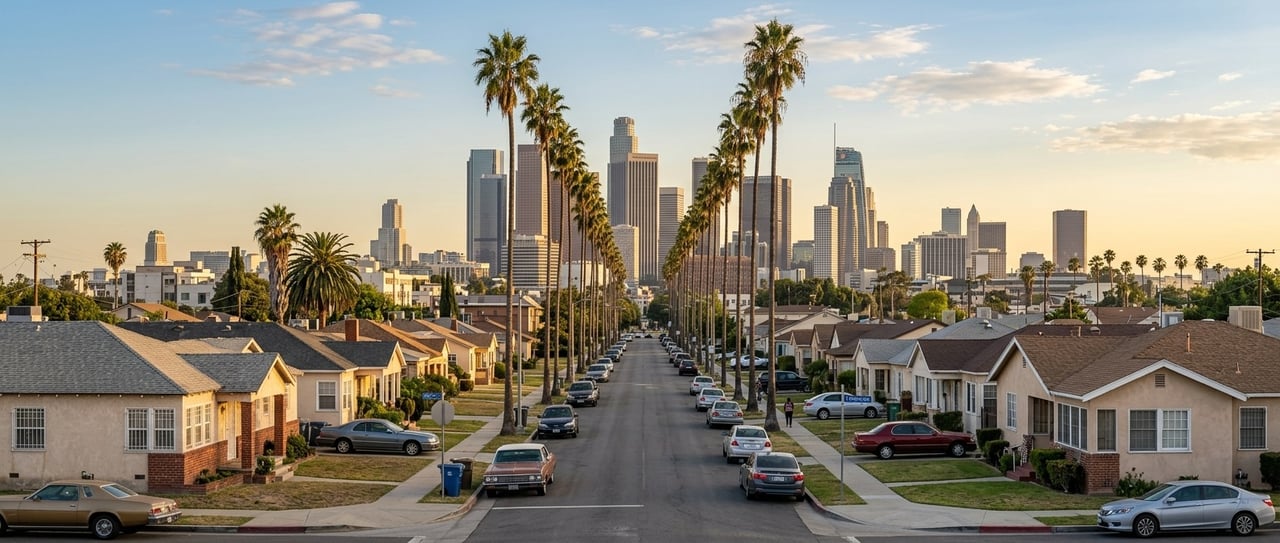
SELA: High-Yield Cash Flow, Density and the Value-Add Playbook
Southeast Los Angeles, spanning South Gate, Huntington Park, Lynwood, Bell and Maywood, has quietly become one of Southern California's strongest submarkets for predictable cash flow. Here is what owners and buyers need to know before their next move.
Unlike coastal trophy markets where buyers accept thin yields in exchange for long-term appreciation, SELA delivers immediate net operating income, lower vacancy volatility and real value-add upside. If you own property in this corridor, or you are exchanging equity out of a low-yield asset elsewhere, the fundamentals are worth a closer look.
1. The SELA Playbook: Strong Cash-on-Cash Returns
For owners who prioritize cash flow over compressed single-digit yields, SELA offers an accessible entry point into one of LA County's densest workforce housing corridors. While Westside assets trade at tight cap rates of roughly 3.5 to 4.5 percent, SELA multifamily properties routinely trade at 5.5 to 6.5 percent or higher. Lower price per door combined with steady blue-collar tenant demand produces a rent-to-price ratio that is hard to match closer to the coast.
Metric | SELA (South Gate, Lynwood, etc.) | Westside (Beverly Hills, Culver City) |
|---|---|---|
Average cap rate | 5.5% – 6.5%+ | 3.5% – 4.5% |
Price per unit | Moderate ($220k – $320k) | Premium ($550k – $800k+) |
Tenant demographic | Local workforce, stable long-term families | Tech, media, corporate professionals |
Primary value driver | Immediate cash-on-cash return | Long-term equity appreciation |
Why regional capital is pivoting here
- Low tenant turnover. SELA submarkets carry some of the lowest vacancy rates in Southern California. Longer tenancies mean fewer turnover costs and more predictable cash flow.
- Steady workforce demand. Proximity to industrial hubs, manufacturing corridors and central logistics networks keeps tenant demand consistent through economic cycles.
2. Garage-to-ADU Conversions: Unlocking Hidden Density
SELA properties often sit on deep lots with long driveways and detached, multi-car garages built mid-century. That footprint is close to ideal for an ADU conversion, and it is one of the fastest ways to add income without touching the main structure.
- Step 1. Identify a detached garage or underused lot space.
- Step 2. Convert to a 1-bed, 1-bath ADU. Build cost typically runs $90,000 to $130,000.
- Step 3. Add $1,750 to $2,100 per month in net new rental income, a 15 percent or higher yield on cost.
Because California mandates ministerial, by-right approval for qualifying ADUs, there is no discretionary design review to slow the process down. That predictability is part of what makes the return math work.
3. Staying Compliant Under AB 1482
Most SELA cities do not layer on a local Rent Stabilization Ordinance the way the City of LA, Beverly Hills or Culver City do. Instead, properties older than 15 years fall directly under the statewide Tenant Protection Act, AB 1482.
Allowable annual rent increases
Annual increases on qualifying properties are capped at 5 percent plus local CPI, up to a maximum of 10 percent. For the LA metro area, that ceiling currently sits at 8.7 percent. Increases can be applied once or twice in a 12-month period as long as the total stays under the cap.
Just cause and notice requirements
- Just cause protections. Once a tenant has occupied a unit for 12 continuous months, termination requires just cause, either at-fault (such as non-payment) or no-fault (such as owner move-in).
- Relocation assistance. No-fault evictions require one month's rent in relocation assistance, or the final month's rent waived.
- Lease disclosures. Every standard residential lease must include a disclosure stating whether the property is subject to or exempt from AB 1482 limits.
4. Westside vs. SELA: The 1031 Exchange Case
Owners across LA County are increasingly weighing low-cap-rate Westside trophy assets against high-yield SELA workforce housing. A fourplex in Beverly Hills or Culver City might run $2.5 to $3.5 million while producing thin cash flow after debt service, insurance and local rent control restrictions. Exchanging that same equity into an 8 to 12 unit SELA property through a tax-deferred 1031 exchange can double or triple monthly cash flow on day one.
Strategic attribute | Westside | SELA |
|---|---|---|
Initial yield | Low (3.5% – 4.5%) | High (5.5% – 6.5%+) |
Rent control framework | Strict local RSOs | Statewide AB 1482 (8.7% cap) |
Capital growth driver | Land value appreciation | Cash-on-cash yield & ADU additions |
Maintenance & capex | Luxury finishes required | Standard durability upgrades |
5. Financing at Today's Rates
With rates staying elevated relative to historical lows, the debt vehicle an owner chooses often decides whether a deal pencils with positive leverage.
- Agency loans (Fannie Mae / Freddie Mac). Best for stabilized 5+ unit assets with steady income. Lower fixed rates, 1.20 to 1.25 DSCR.
- Bridge or private debt. Best for value-add repositioning and higher-vacancy properties. Interest-only, flexible terms.
Lenders typically require a minimum 1.25x debt service coverage ratio, meaning stronger NOI is needed to qualify for maximum leverage in this rate environment. Agency financing offers fixed rates and 30-year amortization but requires stabilized occupancy, generally 90 percent or higher for 90 days. Bridge debt fills the gap for repositioning distressed or under-rented assets until the property is ready to refinance into an agency loan.
6. SB 1211: Up to 8 ADUs on a Multifamily Lot
Senate Bill 1211 expands the state's ADU framework, letting multifamily owners build detached ADUs on surface parking or unencumbered lot space without replacing lost parking.
- Up to 8 detached ADUs. Owners can add detached ADUs up to their existing unit count. An 8-unit property, for example, can add up to 8 detached ADUs.
- No parking replacement required. Cities can no longer require replacement of surface spaces demolished or repurposed for ADU construction.
- Ministerial approval. Projects move through fast-track review with no public hearings, subjective design review or neighbor appeals.
Where This Leaves SELA Owners and Buyers
Whether the play is capturing a 6 percent-plus cap rate in SELA, exchanging out of a low-yield Westside asset, or using SB 1211 to add detached ADUs on an existing parking pad, the market currently rewards proactive asset management. Prioritize cash flow, stay disciplined on AB 1482 compliance, and choose a debt structure that protects the bottom line.
McCann Multifamily Stress Test
See How Your SELA Property Holds Up
Run your property through the Stress Test to see how it performs against rising rates, vacancy swings and a potential ADU or garage conversion, then get a clear read on whether a 1031 exchange into a higher-yield asset makes sense for you.